Fit review
Enquiry management
Capture, assign and review conversion using the institute’s lead process.
Explore capabilityOne visible operating loop for every centre
Give centre teams a clearer path from first enquiry to enrolment, class attendance, tests, collections and approved parent updates—with branch ownership and rollout scope defined from the start.

From enquiry to the next class
Review enquiry movement, collections and cross-workspace indicators in one coherent product story, then release the accepted model centre by centre.
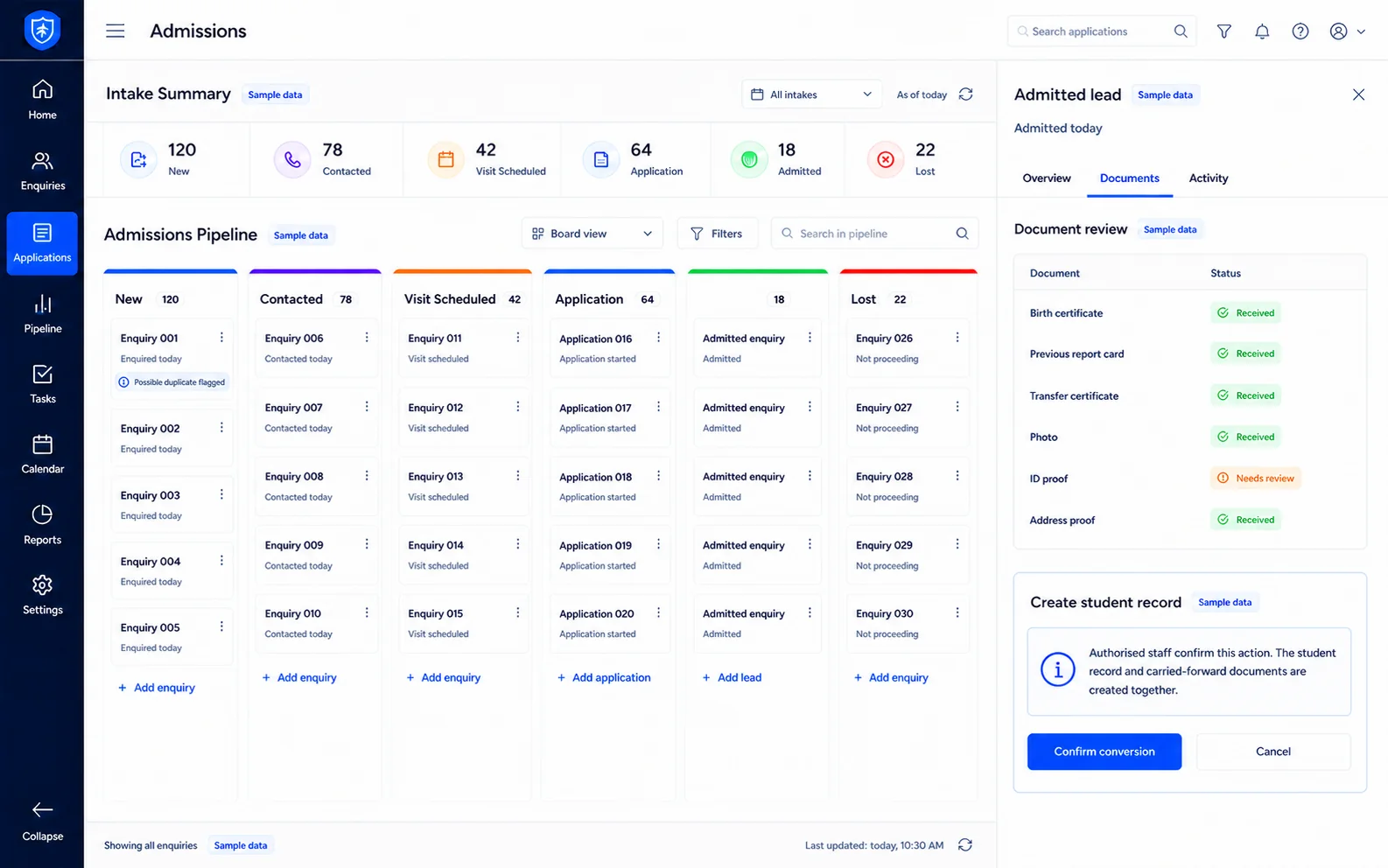
Assignment, follow-up, application, conversion and documents stay in a supervised pipeline instead of separate centre spreadsheets.
A connected operating loop
Enquiries
Review how lead source, ownership, status and conversion evidence fit the institute’s admission process.
Centres and batches
Define centre, batch, subject, faculty and learner group relationships before configuring attendance or tests.
Class day
Use the mapped class-and-section attendance model and configure approved parent notifications where a provider is available.
Instalments
Review fee structures, instalments, pay links and recovery queues using the institute’s actual collection scenarios.
Capability map
Capture, assign and review conversion using the institute’s lead process.
Explore capabilityModel instalments, receipts, dues and provider-backed payment links.
Explore capabilityMap class-and-section attendance to batches before release.
Explore capabilityReview test and result workflows against batch and subject needs.
Explore capabilityModel centres, access boundaries and branch-level reporting requirements.
Explore capabilitySend approved-template updates through a configured provider.
Explore capabilityLooking for the complete inventory? Browse 50+ modules across 9 workspaces.
A clear-fit plan
Institutes ready to map centres, batches, fees and communication rules before rollout.
Batch attendance, online tests, messaging and payment dependencies must be tested against current availability.
Branch access, ownership and reporting expectations belong in the fit record, not in assumptions.
Aira AI
Ask supported questions about records the person is already allowed to see. The source record and permissions remain authoritative.
See the governed AI suiteSwitching
The student import flow maps CSV/XLSX headers, surfaces row-level validation and supports a dry run before commit.
See how switching worksDesigned for adoption
Confirm branches, batches, subjects, faculty, fee structures and role boundaries.
Test enquiry assignment, follow-up, admission and learner creation with real scenarios.
Run attendance, test, result, instalment and parent-update scenarios against available workflows.
Train owners, verify evidence and expand to the next centre only after the previous stage is accepted.
Bring your current process
Plan with confidence
The current attendance foundation is the class-and-section model. The fit review maps the institute’s centres and batches onto it before any rollout claim is made.
The admissions CRM can capture, assign and move enquiries through a reviewed pipeline. The exact stages and ownership rules should be mapped to the institute.
No. Both depend on configured providers and agreed scope. Readiness and delivery state should be verified before release.
Yes. A staged release can begin with one mapped centre, validate operations and evidence, then expand using the accepted configuration.
Start with evidence
Use the trial and a workflow review to confirm scope, providers, data migration and plan availability before a wider rollout.