Vidyapeeth Demo School
Published result preview
- Learner
- Sample learner
- Class
- Class · Section
- Reporting period
- Selected term
Board configuration and publication state remain visible
Board-configured report cards

Feature identity
Result Publishing
An illustration, not a screenshot. The interactive example below shows what this capability actually does.
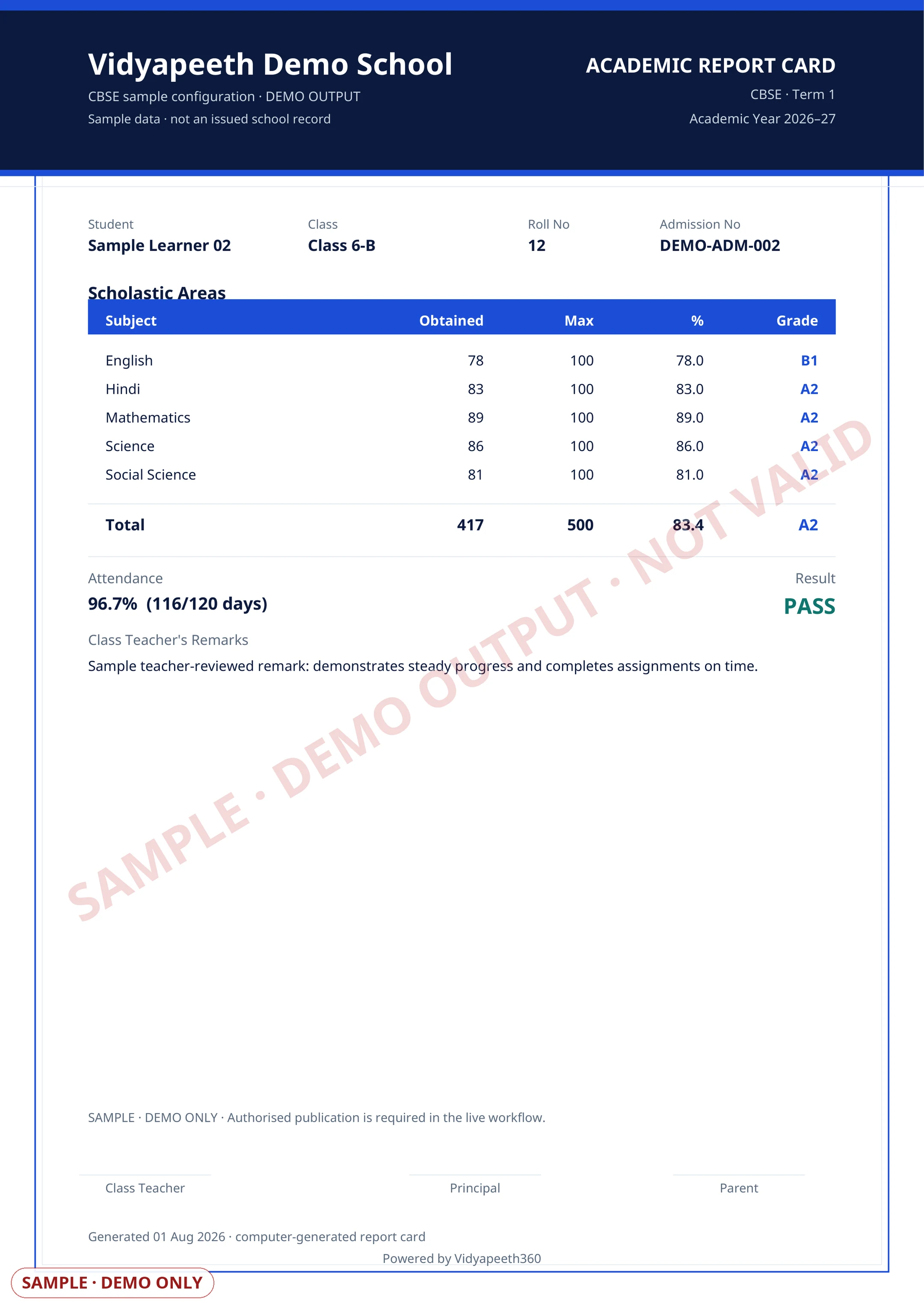
Board-configured report cards
Standard report card output. Rendered by the shipped report-card PDF renderer from a deterministic fictional learner fixture.
Published result preview
Board configuration and publication state remain visible
Product scope
One click turns entered marks into branded, board-aware report-card PDFs — grading bands, pass marks and NEP HPC domains come from the school's board configuration, never hard-coded. The no-code Report Card Studio lets the school redesign layout, signatories and grading scales itself.
The school problem
School teams need a dependable way to handle Result Publishing: Board-configured report cards. The required records, assigned roles and review boundary must remain explicit.
Day-to-day work
Board-configured report cards.
Operational result
Issued board-aware report cards whose grading, template, attendance and signatory context remain reproducible on re-download.
Access and ownership
What each person can actually see depends on the role you give them and which classes or records you assign.
Availability and setup
Academics catalogue capability
Flagship workflow deep dive
From marks entry to publication — without spreadsheet drift.
Configure terms, papers, board scales and report-card rules from the school's academic setup. Teachers enter scoped marks, moderators review exceptions, and authorised staff generate and publish report cards through distinct controlled stages.
Interactive operating model
Move through the evidence behind a card; the visual stops at every point where academic authority is required.
Stage 1 of 5
Configure
The school resolves its board scale, term, papers, assessment types and report-card design.
Control point
Board configuration is authoritative; AI does not create the grading policy.
Evidence retained
Resolved scale, paper settings, signatories and template version.
Core workflows and features
Aira for analysis and remarks
Aira can explain aggregate exam patterns and prepare a board-aware class-teacher remark from permitted marks, attendance and configured academic context. The returned text remains an editable draft.
Human boundary
Aira does not assign or change marks, determine pass or fail, approve moderation, sign a card, publish results or release a withheld card. Teachers and authorised examination staff own every saved remark and publication decision.
Key daily uses
Used by
Actual access follows the school's plan, role permissions and record scope.
Measurable operating indicators
Establish a baseline before rollout, agree the reporting period, then compare the school's own source evidence.
Entered or explicitly absent cells ÷ expected mark cells
Makes missing entry work visible before publication rather than hiding it in a class average.
Complete, partial and missing student records before generation
Shows which records need review before a batch is generated.
Pending moderation, withheld cards, reopened papers and correction events
Tracks governed exceptions without treating publication speed as the only quality measure.
Prerequisites and availability
Academic catalogue capability · board configuration required · optional Aira on plans that include it
Connected operating context
These are the documented neighbouring capabilities that school teams may review with this module. A related page does not imply that every hand-off is automatic or enabled in every plan.
Buyer questions
The questions school owners ask before they subscribe: what it does, who can see it, and what to set up first.
Not silently. Published marks lock, and the sanctioned exception is the re-evaluation workflow: a family requests a re-check of one paper, an authorised re-marker revises that single mark, and the result re-derives with the trail preserved.
Grading is configuration, not code. Bands, pass marks and the marks-versus-grades scale come from your board configuration, so a percentage-only state-board card and a grade-point card both render from the same engine.
Yes. Publishing is term-level, and an authorised person can additionally withhold an individual card with a recorded reason; the family's portal does not show it until it is explicitly released.
Digital Gradebook, Exam Reports, Report Card AI, Export PDF are the documented neighbouring capabilities. They help a school evaluate the surrounding hand-offs, but a related page does not mean every integration is automatic or included in every plan.
Completed marks, board configuration and an approved report-card template. Confirm plan scope, role permissions, data dependencies and any provider or migration prerequisites during the demo and proposal.
Optional Aira or AI assistance. Aira supports only the reviewed actions listed on this page, and authorised people remain responsible for confirming material actions.
Plan inclusion and rollout scope depend on the live plan matrix, readiness state and your school's written proposal. The demo team will confirm the applicable boundary before rollout.
Related evaluation guides
See it in your school context
See how this workflow fits your school's current records, roles, plan and rollout requirements.